Jul 14, 2026 | Electrical, EV Charging
Home » How Fast Does a Home EV Charger Actually Charge?
Most people buy an electric car before they think hard about how they will charge it. Then the first power bill and the first slow overnight charge arrive, and the questions start. How fast should a home charger be? Is faster always better? And why did the salesperson say “22kW” when the car never seems to hit it?
We install home EV chargers across the Gold Coast every week, so we field these questions all the time. Here is the straight version, with real numbers and no jargon.
The slow truth about charging from a normal power point
Plug your EV into a standard 10-amp wall socket, the same one your kettle uses, and it will charge. It will just take a while. A very long while.
A regular power point trickles in around 8 to 12 kilometres of range per hour. Leave the car plugged in for a full 10-hour overnight stretch and you might add 80 to 120km. That is fine if you drive a short commute and never forget to plug in. It falls apart the moment you do a big day of driving, or you own a larger battery, or you simply forget one night. You wake up to a car that is nowhere near full.
There is a safety angle too. Standard power points and household wiring were never designed to deliver high current for 10 hours straight, night after night. Running an EV off a general power outlet long term can overheat the socket and the circuit. It is one of the most common reasons we get called out. If you are charging on a normal power point today, treat it as a temporary fix, not a solution.
Expert Tip:
Hiring a licensed electrician is essential for an EV charger switchboard upgrade because connecting a dedicated high-load circuit and upgrading the board are licensed works in Queensland, and doing it right the first time means a compliant, safe setup with the certificate you need, no overloaded board, lower fire risk, no surprises.
Proper home charger: single-phase vs three-phase
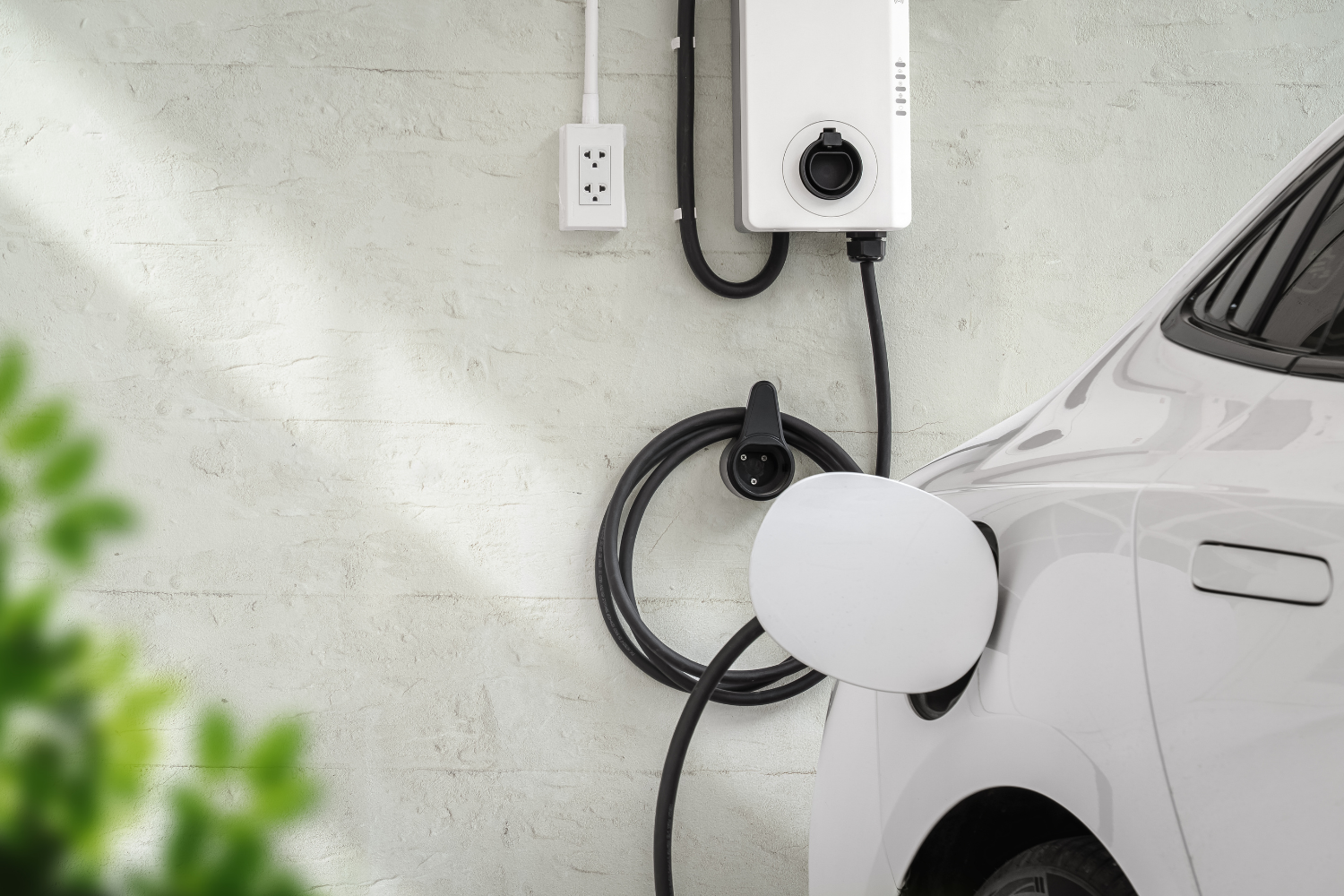
A dedicated home charger (often called a Level 2 AC charger) is a different world. It runs on its own circuit, wired straight back to your switchboard, and it charges several times faster than a power point.
How fast it is depends on the power supply coming into your home.
Single-phase power is what most Gold Coast homes have. A single-phase charger delivers up to 7.4kW, which adds roughly 40km of range per hour. For the average driver, that is more than enough. A typical daily commute tops up in under an hour, and the car charges from near-empty to full comfortably overnight.
Three-phase power brings three live wires into the property instead of one. A three-phase charger can push much more power, and in the real world you will see around 30 to 40km of range per hour on most electric cars. That is the sweet spot we recommend for households with two EVs, larger batteries, solar they want to soak up quickly during the day, or anyone who values getting a big top-up in a couple of hours rather than overnight.
Here is the honest catch that a lot of sellers skip over. A charger rated at “22kW” almost never charges a normal car at 22kW. The limit is not the charger, it is the car. Most electric vehicles sold in Australia have an onboard AC charger that accepts a maximum of 7kW or 11kW, no matter what the wall unit is rated for. Only a handful of models can actually pull the full 22kW. So a three-phase charger is worth it, but for the smart-charging features and headroom, not because the badge says 22.
We check your car’s real onboard charging rate and your home’s supply before we recommend anything, so you pay for charging speed you can actually use.
Charging speeds at a glance
Charging method Typical real-world speed Best for
Standard 10A Power point 8 to 12 km per hour Emergencies only, not for daily use
Single-phase home charger (7.4kW) 40 km per hour Most Gold Coast homes, one EV
Three-phase home charger 30 to 40 km per hour (car dependent) Two EVs, big batteries, fast solar charging
Public DC fast charger 150 to 300+ km per hour Road trips and top-ups on the go
Faster isn’t always better: what DC fast charging does to your battery
Public DC fast chargers are brilliant when you are on a road trip and need a range in 20 minutes. Nobody is arguing with that.
The issue is using them as your everyday charger. DC fast charging forces a large amount of energy into the battery in a short time, which generates heat. Do that occasionally and your battery shrugs it off. Do it every day for years and the repeated heat and high charge rates can accelerate battery ageing, which shows up as reduced range down the track.
Slower AC charging at home is gentler. The battery stays cool, the charge is steady, and your car’s battery management system has time to balance the cells properly. For the health of the most expensive component in your car, charging at home most of the time and saving the fast chargers for trips is the smart play. Your driveway is the best thing you can do for your battery and for your wallet.
What installation involves
Fitting a home charger is usually a few hours of work, not a major project. When we install one, we:
Assess your switchboard and electrical supply
Recommend the right charger and power option for your car and home
Run a dedicated circuit to your garage or carport
Mount, install, test and commission the unit
Walk you through the app and the charging modes before we leave
If your older switchboard needs an upgrade first, we will tell you at the quoting stage. No surprises on the invoice.
Ready to charge smarter at home?
You do not need the fastest charger on the market. You need the right one for your car, your home supply and your solar, installed safely and correctly the first time.
As your local Gold Coast electricians, we supply and install both Smappee and Zappi with a $0 call-out fee and fixed pricing. Voted the Gold Coast’s best electrician by the Gold Coast Bulletin, we will get your EV charging setup sorted properly.
Article Author
Joel Crapper
Joel is the founder of All Access Electrical, bringing over a decade of hands-on experience in residential, commercial, and emergency electrical services across South East Queensland. Joel shares practical advice, safety tips, and insights to help homeowners and business owners understand their electrical systems, Air conditioning and CCTV Systems to make informed decisions.
All Access Electrical – for all your electrical and data needs in and around South East Queensland. Contact us for a free quote from your local Gold Coast Electrician. Are you looking for a Gold Coast Electrician to help you with all your domestic and industrial electrical work on the Gold Coast? Look no further than All Access Electrical.
Reviews
Careers
Commercial
Residential
Body Corporate
New Homes & Renovations
Smoke Alarms
CCTV & Data
Emergency Electrician
Air Conditioning
Security Cameras
Burleigh Heads, QLD, 4220
admin@allaccesselectrical.com.au
Licence Number 82801
RTA Licence AU62513
Terms & Conditions
* “No call out fee” does not apply to:
Same day service;
After hours / Emergency call outs:
Is subject to availability & not available during peak times or office closure.
2. “Free quotes” does not apply to:
Investigation of air conditioning faults / breakdown or error codes;
Investigation of electrical faults
3. “Same day service” is subject to availability and may be charged as After Hours.
4. Pre payment may be required for after hours call outs.